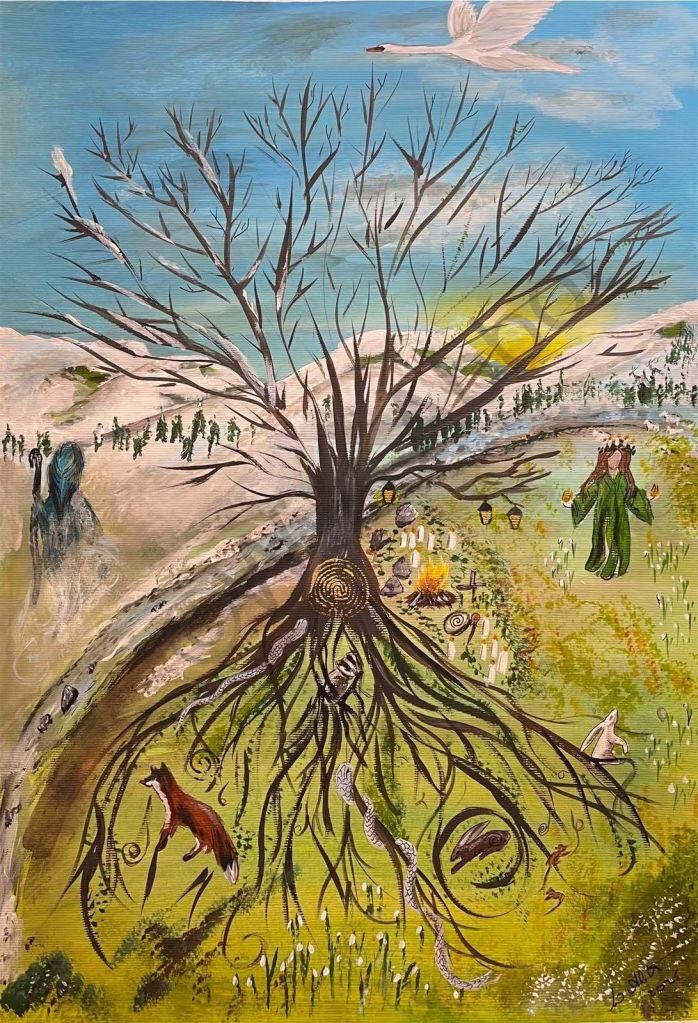
Artwork © Wyn Abbot. All rights belong to the artist.
Introduction: Divine Figures in the Turning of the Year
The figures of the Cailleach and Brigid occupy a central place in Gaelic seasonal lore, representing the shifting forces of winter and spring in the landscapes of Ireland and Scotland. Although they emerge from different strands of myth and folklore, together they articulate a cyclical pattern that governed the agricultural year and shaped community ritual. Their roles are not merely symbolic; they reflect a worldview in which the seasons themselves are personified as divine powers acting on the land.
The Cailleach and the Dark Half of the Year
The Cailleach is closely associated with the dark half of the year. In many Scottish traditions, she rules from Samhain on 1 November until Imbolc on 1 February, during which time she governs storms, snow, and the cold stillness of winter (Carmichael 1928). She appears as an ancient, often terrifying figure who beats the ground with her staff to freeze it or washes her plaid in the whirlpool of Corryvreckan, whitening the landscape. These stories highlight her role as the force that shapes and preserves the land, marking her as a sovereignty figure whose authority is expressed through the rigours of winter. Her actions signal the need for dormancy, rest, and the hardening of the natural world before the return of fertility.
Brigid and the Emergence of Spring
Brigid, by contrast, is associated with the first stirrings of spring. Her festival at Imbolc marks the moment when the land begins to quicken after the winter’s stillness. Early Irish sources portray her as a goddess of healing, fertility, poetry, and inspiration (Ó hógáin 1999), all qualities associated with renewal and the reawakening of life. In folklore, the arrival of Brigid brings longer days, the first milk of the ewes, and the gentle thawing of frozen ground. The Christian figure of Saint Brigid retains this seasonal role, and her feast day on 1 February continues to mark the transition into the lighter half of the agricultural year. Homes were traditionally prepared to welcome her presence, and her visit was believed to bring warmth, blessing, and the promise of the coming spring.
The Seasonal Transition at Imbolc
The transition between the Cailleach and Brigid is one of the most evocative features of Gaelic seasonal lore. In some Scottish tales, the Cailleach holds Brigid captive during the winter months, only releasing her at Imbolc, symbolising the thawing of the land and the renewal of life (Black 2019). In other traditions, the relationship is framed as a succession of rules: the Cailleach reigning through the cold months while Brigid assumes authority as the days lengthen. A particularly striking strand of folklore suggests that they are not separate beings at all, but two seasonal aspects of the same goddess who transforms at the turning of the year. In these accounts, the Cailleach drinks from a magical well at midwinter to regain her youth, becoming Brigid until the cycle turns again (McNeill 1959). This idea reflects the older motif of the sovereignty goddess who shifts between forms, embodying the land in both its harsh winter guise and its fertile spring face.
Seasonal Meaning in Gaelic Life
These associations with the seasons were profoundly meaningful to agricultural communities. Winter’s severity, represented by the Cailleach, was understood as necessary for survival, providing a period of stillness that preserved resources and strengthened the land. Spring’s arrival under Brigid’s influence ushered in fertility, warmth, and the renewal of food sources. The dynamic between these two figures, therefore, expressed the deep interdependence of death and rebirth, hardship and healing, darkness and emerging light.
Conclusion: Two Goddesses, One Year
Taken together, the Cailleach and Brigid embody the rhythm of the year as experienced in the Gaelic world. The Cailleach represents the shaping, conserving, and often destructive forces of winter, while Brigid represents the creative, life-giving, and inspirational energies of spring. Whether regarded as adversaries, successors, or transformations of a single divine power, their interplay reflects the continual turning of the seasons, grounding the agricultural cycle in mythic and spiritual meaning.
 The Illuminated Pathway